Blog
Blog
The Data Gap Behind Your AI Search Answers

In Localistico’s own survey, we asked senior leaders how ready their location data was to support their AI ambitions. Fewer than 1 in 3 said yes, which means most brands cannot yet count on giving accurate AI search answers to their own customers. These are people already spending the budget on AI, but the data foundation underneath it is not solid enough for AI to work with. We see a similar pattern across sectors, from retail to hospitality.
Most of the multi-location brands we work with are just starting to think about AI visibility at a local level. They have invested heavily in their in-store experience, their national marketing, and their digital channels. But how each individual location shows up in AI-generated answers is a new question for most of them.
Why This Matters Now
AI assistants are increasingly where local questions get answered, and getting recommended by them runs on a different set of rules from ranking in traditional search. This is what we mean by GEO, Generative Engine Optimisation: the practice of making sure your brand and your individual locations are structured so AI models can find, trust, and recommend them. We have covered the relationship between SEO and GEO in detail here; in short, the two run alongside each other rather than one replacing the other.
Where Does the Wrong Information Actually Come From?
The source of wrong information might surprise you. AI does not just pull from your Google Business Profile or your website homepage. It scrapes from everywhere: directories, aggregators, cached pages, and sources you never thought to check. An outdated PDF sitting in a forgotten corner of your website. A listing on a directory you signed up to five years ago and never updated. A page that should have been taken down when you changed your opening hours. The LLM finds all of it, and it has no way of knowing which version is current.
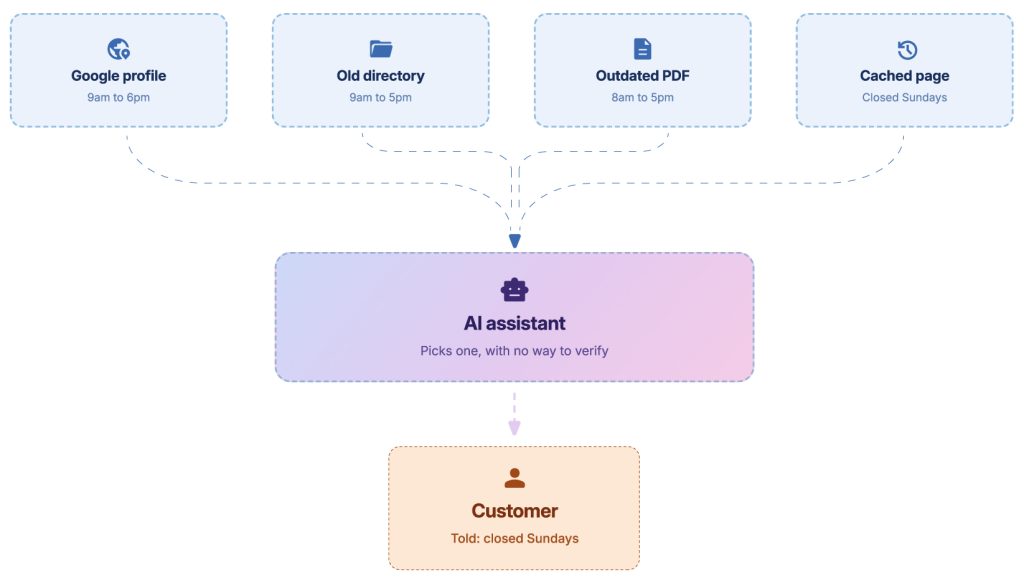
That is before you even get to hallucination, where the LLM confidently generates an answer that is not based on your data at all, but on something loosely related it found elsewhere on the internet. The result is the same either way: the customer gets the wrong information, and you have no idea it is happening.
A Small Error, Multiplied
Consider a brand with hundreds of locations. Even a small data error means a significant number of locations simultaneously misleading customers across every AI-powered channel. A customer asks where the nearest branch is open on Saturday. The AI pulls the data it can find. If those locations have the wrong hours, the customer gets the wrong answer. They show up, the branch is closed, and the trust is gone. That customer experience breakdown starts long before they ever walk through the door.
What’s Actually at Stake
The consequences go beyond losing one customer. LLMs do not just omit your brand and location when data is incomplete or inconsistent. They can actively mislead customers by pulling from outdated sources, or even from content about a completely different business. A customer asks whether your branch has wheelchair access, or whether a location is allergen-safe. AI pulls whatever it can find and answers confidently, even if that information is wrong or belongs to a previous tenant of the same address.
If the customer then acts on it, that is not just a lost sale. Depending on the situation, it can be a reputational issue or worse. Because AI does not always show its working clearly, most customers will not check the source. Localistico’s survey found that around two thirds of consumers are not rigorously fact-checking what LLMs tell them about local businesses, which represents significant exposure for any multi-location brand.
Closing the Gap
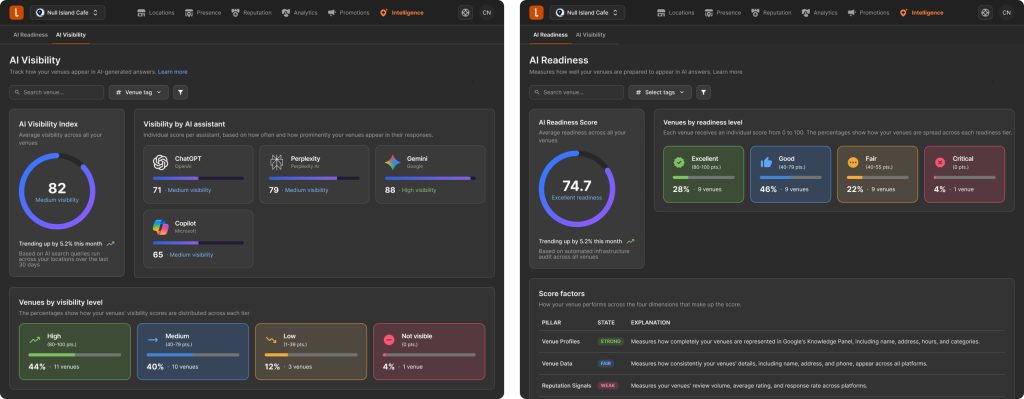
We have built a set of AI capabilities designed to close exactly these gaps: an AI Readiness Score for each location, an AI Visibility Index benchmarked against local competitors, AI Powered Insights that prioritise what to fix, an AI Content and SEO Assistant that generates optimised content at scale, and AI Review Topics Analysis that surfaces themes across thousands of reviews. We have written about these capabilities in full here; the short version is that each stage builds on the one before it.
Three Things to Do This Week
- Check your AI Readiness Score. If you are already a Localistico client and have this feature activated, log into the platform and look at the scores for your locations. Identify the ones dragging your average down. That gives you your starting point. If you are not yet a client, request a demo and we will show you where your locations currently stand.
- Look at your review response rate. Reviews are one of the strongest signals for AI search platforms. If you are not responding consistently and at scale, you are leaving one of the most powerful tools untouched. The AI Content and SEO Assistant can help you do this without it taking hours of your team’s time. It is also worth thinking beyond reviews: AI pulls from a wide range of sources including blogs, local press, community sites, and directories. If your locations are not mentioned in those places, you are invisible to a significant part of how AI builds its answers. Get in touch and we can help you understand where your unstructured presence stands.
- Talk to us. Whether it is about your store pages, your data consistency, or understanding your AI Visibility, we are here to help you take the next step. Get in touch and we can talk through where your brand stands today. You do not have to figure this out on your own.
Key Takeaways
- Localistico’s survey found that fewer than 1 in 3 senior leaders feel their location data is ready to support their AI ambitions, despite active investment in AI.
- AI pulls from far more sources than your Google Business Profile or website, including outdated directories, cached pages, and forgotten PDFs, and it has no way of knowing which version is current.
- A single wrong data field can mislead customers across every location that shares it, all at the same time.
- Localistico’s survey found that around two thirds of consumers are not rigorously fact-checking what LLMs tell them about local businesses, which raises the stakes of getting your data wrong.
- GEO and SEO run alongside each other. GEO does not replace the local SEO work you have already done, it builds on top of it.
If you would like to go deeper, get in touch and we will help you understand exactly where your locations stand, or request a demo to see how it works.